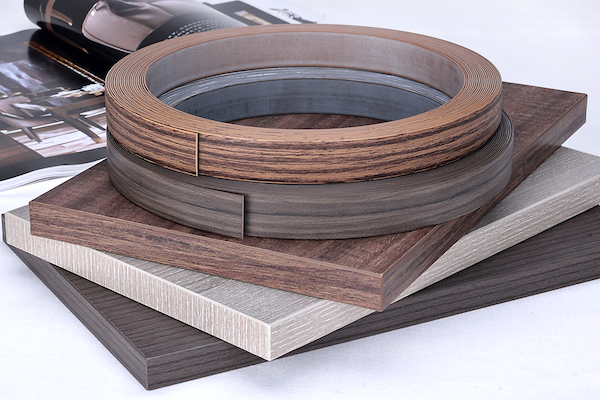
You band a panel, run it through the trimmer, and the machined face of the banding comes out pale. On a dark decor it looks like a thin chalk line. On white it looks dull or grey. Either way, the joint that was supposed to disappear is now the most visible part of the panel.
This is not a cosmetic accident. It is the interior of the material becoming visible, and the cause is either what the band is made of, how it was cut, or both. The good news is that the two can be separated in about ten minutes.
Take an offcut of the banding, about 100 mm long. Clamp it flat. With a brand new blade in a sharp knife, cut straight across it in one firm stroke, without sawing.
Do this before you call your supplier or your machine technician. Most arguments about who is responsible end at this step.
PVC compound is a blend of resin, plasticiser, stabiliser, pigment and calcium carbonate. Calcium carbonate is the cheapest ingredient and the one that most easily gets increased when a supplier wants to win a price comparison. A band with a high filler load looks correct on the roll. It only shows its true nature when the cut face is opened.
The practical measure is PVC content, and the practical test is the knife cut above. If a supplier cannot tell you roughly what resin content their compound carries, that is information in itself.
Some decorative effects, particularly dark wood grains and metallic looks, are produced by printing a film or a thin layer that sits on top of a base material of a different colour. When the trimmer penetrates past that layer, the base colour appears. This is normal for that construction and it is why the thickness of the decorative layer, not only the total thickness of the band, matters for heavily machined edges.
If the compound was not mixed and gelled evenly, the band develops hard and soft zones along its length. The hard zones cut cleanly and the soft zones smear, so the same panel can show a clean edge on one side and a white edge on the other. The giveaway is inconsistency along a single roll.
A dull cutter does not slice, it pushes. Pushing deforms the polymer ahead of the edge, and deformed PVC turns pale. Trimmer inserts are consumable, and on a three-shift line they wear out faster than most maintenance schedules assume. Check the rake angle as well: a tool ground for solid wood is not the right geometry for a thermoplastic.
End trimmers and radius scrapers set too aggressively create stress whitening, the same effect you get when you bend a piece of clear plastic until it goes cloudy. The cut looks dimensionally correct but the surface is milky. Reduce the spring or pneumatic pressure and the line usually disappears.
Too fast a feed against a fixed cutter speed produces torn, rough edges that read as white. Too slow a feed generates heat, which softens the band and causes it to smear rather than shear. Both produce the same visual complaint from the customer and both are cured by setting the machine to the material rather than the other way round.
Edge banding applied in an unheated workshop in winter is more brittle than the same band in summer. If whitening appears only in cold months, the material may be fine and the workshop temperature is the variable. Bring rolls to room temperature for 24 hours before running them.
When you write the purchase specification, or when you approve a supplier, ask for these four things.
This defect is common enough that it shaped how we buy raw material. The bands we produce use a high PVC content compound specifically because the trimmed edge keeps its colour. It costs us more per kilogram than a filler-heavy alternative, and it is the reason panel makers who run three shifts can band dark decors without a visible line.
You can see the material range on our PVC edge banding page and ABS edge banding page, both of which are tested to SGS and ROHS standards and to California Proposition 65.
On PVC, a light pass with a polishing wheel or a controlled solvent wipe can reduce the appearance, which is why some lines include a polishing unit. It treats the symptom. If the cause is filler in the compound, the line returns as the polished surface dulls.
It is more visible on dark colours, yes, because the contrast between the decor and the pale cut face is higher. The underlying material behaviour is the same.
Thicker banding exposes a larger cut face, so the line is wider. Thin banding hides the defect better, which is one reason very cheap panels sometimes look acceptable at 0.4 mm and fail immediately when a customer upgrades to 2 mm.
ABS is generally less prone to this, partly because the material is tougher and partly because ABS compounds are less commonly loaded with cheap filler. It can still whiten from blunt tooling or from excessive trim pressure.
If you are currently rejecting panels and cannot tell whether the banding or the trimmer is responsible, send us a short length of the banding and a photo of the trimmed edge in daylight. We will tell you what we see.
Send the details through our inquiry form and include the decor name, the thickness you are running and the type of edge bander. Our team replies within one business day.

